


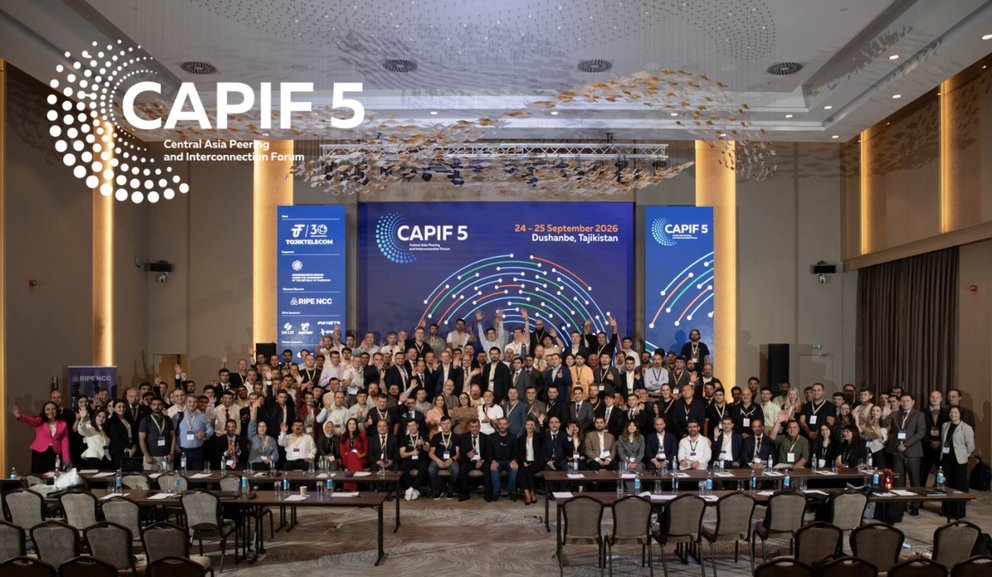
More local peering, stronger routing security and a shared ambition to improve connectivity: CAPIF 5 brought Central Asia’s Internet community to Dushanbe to compare progress, discuss persistent challenges and learn from the people building the region’s networks.
Ahead of CAPIF 5, we put together a regional report that showed signs of a more interconnected Central Asia, with more direct routes between neighbouring countries and fewer long detours outside the region. In Dushanbe, the people building and operating those networks gathered to share their experiences and discuss what comes next.

The fifth Central Asia Peering and Interconnection Forum (CAPIF 5) - the first to be held in Dushanbe, Tajikistan - took place on 24-25 September 2026, bringing together 229 participants from 23 countries.
Organised with the support of the Communications Service of the Republic of Tajikistan and the national telecom operator, Tojiktelecom, the event was one of several industry events and initiatives this year where local network operators have come together to work towards better connectivity across the region.
Watch the video from the Head of the Communications Service under the Government of the Republic of Tajikistan, Isfandiyori Sa'dullo:
Keeping regional traffic local
The call to keep regional traffic local was already being heard at CAPIF 1 and has grown louder with each meeting since. Discussions have focused on how to put this into practice: establishing more local peering, improving traffic paths, and building in the redundancy needed to keep the region connected when links fail.
The takeaway is that Central Asia is now building new digital corridors and connectivity is becoming more direct and diversified, although improvements in routing diversity have not always translated into more efficient traffic paths.

A number of speakers at CAPIF 5 continued to tackle these topics from various angles, looking at how far the region has come on this front, and what comes next:
- Bakhtovar Abdusattorzoda, Tojiktelecom - Keeping Central Asian Traffic Local
- Oleksiy Semenyaka, RIPE NCC - Interconnectivity in Central Asia: 2022, 2024, 2026
- Paulius Vaina - Connectivity for Central Asia
Peering and the growth of IXPs
In the early days of CAPIF, discussions about IXPs were more about the “why” and “how”. At CAPIF 5, we saw that regional attendees have moved well beyond the rudiments to engage in serious questions about the growth of IXP participants, the localisation of large CDN servers, and distributed regional peering models.

The number of IXPs grew from a few in 2022 to 22 IXPs across four countries. One thing of note here is how many of these IXPs are national, having been established through government-led initiatives - e.g., KazIX, UZ-IX, TJ-IX. Such action on the part of governments in the region is no doubt commendable and helps establish the IXP ecosystem, but it was also noted that the focus on national exchange points should be perceived with caution, as the IXP market thrives best as an open market.
For more insights on these developments, here are several of the talks from CAPIF 5 that delved into peering and IXPs:
- Oleg Yemelyanov - Peering and Interconnection in Kazakhstan: Recent Legislative Developments
- Robbie Mitchell, ISOC - Dissecting the Cost of Peering at IXPs'
- Anton Tarassov - IXP and IPv6 in Central Asia
- Sergey Mazurov KG-IX - IXP in Kyrgyzstan
- Bernd Spiess and Bülent ŞEN, DE-CIX - Learnings from 15 Years building peering at UAE-IX
IPv6 might be around the corner
Global IPv6 adoption is gradually growing, but Central Asian countries still fall somewhat behind the curve. However, it looks like the sharp spike is not that far away. To support the fast-paced digital transformation that the region is overseeing, operators are modernising their infrastructure that now supports IPv6.
Given the vast population in the region - according to the World Bank, the total population of Central Asia amounted to about 86 million in 2025 - IPv4 scarcity makes it harder to meet the region’s growing connectivity needs. And the rapid digitalisation of the region makes transition to IPv6 even more inevitable, as dual stack can be costly and there is proof that IPv6-mostly and even IPv6-only are all possible.
Check out the talks on IPv6:
- Dmitriy Melnik, RIPE NCC - IPv6-Mostly: Is It Coming?
- Buzurgmehr Davlatzoda - IPv6 Deployment and Operations
- Anastasiya Pak - RPKI Deployment and IPv6 Uptake In Central Asia: Update from CAPIF 4
Routing security skyrocketing
One area in which Central Asia has shown immense progress is, without a doubt, routing security and RPKI deployment. At the RIPE NCC, it gives us a very strong sense of accomplishment to see how spikes in RPKI uptake match the timeline of our engagements with operators in the region. For example, after CAPIF 4 in Almaty last year, Kazakhtelecom signed their ROAs. Tojiktelecom also followed suit after Internet Measurement Day Tajikistan last year.
Furthermore, just before CAPIF 5, the RIPE NCC hosted a series of training sessions during which some major operators signed their ROAs increasing the IPv4 ROA coverage from 40% to 62% at CAPIF 5 and now 74%. This is a real success story, and we’re already looking forward to next steps, like further implementation of route origin validation and more signing of ASPA objects!

Talks on routing security practices and measurements:
- Anurag Bhatia, Hurricane Electric - ASPA - RPKI for Path Validation
- Ehsan Ghazizadeh, Sotoon Cloud - ASPA: The path to securing BGP
- Milad Afshari, MTN Irancell - The Routes That Never Leave…
- Anastasiya Pak, RIPE NCC - RPKI Deployment and IPv6 Uptake In Central Asia: Update from CAPIF 4
Panel session: The evolution of Central Asia and its Internet
When the Soviet Union broke up in 1991, five Central Asian republics that had been part of one very big country had to find their own way. After years of shared infrastructure, history and connections between people, the newly independent Central Asian countries each began building their own Internet infrastructure. They took different paths but faced many of the same challenges: reaching global submarine cable networks from a landlocked region and, in some countries, connecting communities across mountainous terrain.
Watch the panel session:
The choices made along the way have shaped the region’s Internet. We can trace some of that history through routing decisions, including changes in transit providers over the past 20 years.
Advances in agentic AI offer new ways to document and analyse this history. But the data alone cannot tell the whole story. The people who built these networks, and who keep them running today, can explain the circumstances, constraints and ambitions behind those decisions. Recording their experiences will give those studying today’s Internet tomorrow a fuller picture of how it came to be.

Other talks at the event also covered different aspects of this broader story:
- Jim Cowie, The Internet History Initiative - Central Asian Stories: How AI Tools are Changing the Way We Study Internet History
- Ties de Kock, RIPE NCC - A History of Internet Routing in Central Asia as seen from RIPE RIS
- Dmitry Kovalenko, msk-ix - Evolution of the DNS resource records of country code top level domains in Eastern Europe and Central Asia
Until next time
There were many more interesting talks and discussions than we could cover in this report. But what we value most about CAPIF is being there: the conversations, the warmth of the people and the hospitality of our hosts. Those personal connections are an important part of how this community continues to grow.

If you missed CAPIF 5, recordings will be available in English, Russian and Farsi on this channel. And as we look ahead to the next gathering, the call for hosts for CAPIF 6 is still open.
We’ll be tracking further developments and sharing them with you ahead of the next event. We hope to see you there!
Watch the CAPIF 5 aftermovie:

Comments 0