





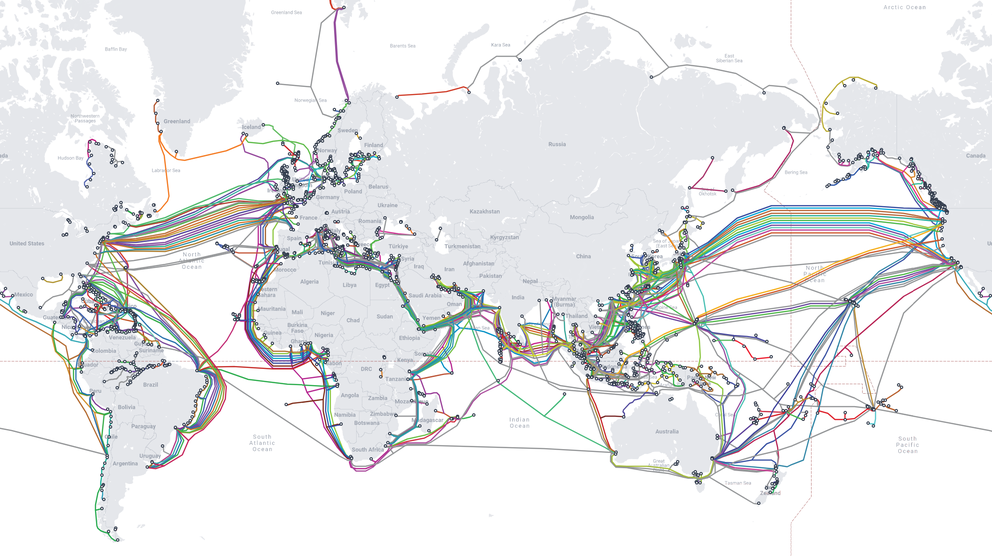
Content and cloud platforms are no longer just the largest customers of global connectivity. They are increasingly financing and building the infrastructure itself, from submarine systems to edge and data center footprints.
Internet core increasingly built by hyperscalers, not traditional carriers
A structural shift is underway in how global Internet infrastructure is financed, built, and controlled. The firms that generate the largest traffic volumes are no longer simply customers of the network. They are increasingly building the network themselves.

TeleGeography’s State of the Network 2026 makes this visible in the data. Content and cloud networks now account for roughly 75% of global international bandwidth demand, up from a minority position a decade ago. On the largest routes, they now account for more than 80% of used bandwidth. This is no longer an emerging trend. It is already structurally visible.
On the largest routes, the change is even clearer. Content and cloud networks now account for more than 80% of used bandwidth on trans-Atlantic, trans-Pacific, and intra-Asian routes. Europe-Middle East routes remain more balanced, but the direction is the same. The firms that drive demand are increasingly also shaping the infrastructure that carries it.
This is not only a traffic story. It is also a capital allocation story, an ownership story, and increasingly a geography story.
Traffic demand no longer sits where it used to
For many operators, this shift is already visible in day-to-day upstream traffic patterns. The dominant flows no longer come primarily from traditional transit providers. They come from content and cloud networks, either directly or through their edge nodes.
That matters because it changes where influence sits in the system. Historically, backbone providers occupied the strategic center of international connectivity. They aggregated demand, controlled long-haul routes, and monetized scarcity across intercontinental infrastructure. That position is weaker than it used to be.
The center of gravity is moving towards firms that control large-scale demand and can justify infrastructure investment not as a standalone telecom business, but as part of a broader internal platform model. Connectivity is no longer just a product purchased from the market. For the largest platforms, it is increasingly part of their own production stack.

Google’s cable between South Africa and Australia is one example. In the traditional carrier model, this is not an obvious route. In the hyperscaler model, it makes more sense. It is not a telecom service in the old sense, but internal infrastructure linking compute, storage, data center, and cloud footprints.
At scale, this is now what the investment cycle looks like. Submarine cable construction costs are expected to exceed USD 6 billion in 2026 alone, a level not seen since the dot-com era. The aggregate value of planned systems through 2027 may exceed USD 14 billion. The dominant source of capital in that cycle is no longer the traditional carrier base.
Google’s Pacific Connect Initiative and Meta’s Project Waterworth point in the same direction. These firms are no longer simply content companies buying transport. They are infrastructure operators building for their own demand.

The infrastructure stack is becoming vertically integrated
This is an important distinction. Traditional carriers built networks in order to sell connectivity. Hyperscalers build connectivity in order to support compute, storage, application delivery, and service control. The business logic is different, which means the investment logic is different too.
The same firms that increasingly dominate international traffic demand are also extending their position across other layers of the infrastructure stack. Submarine systems, cloud regions, edge nodes, data center footprints, and private backbone capacity are becoming parts of the same integrated model.
For traditional operators, the commercially defensible space is therefore narrowing. Hyperscalers increasingly own the cable, the data center, the cloud region, and the edge node. The operator still retains important assets, especially in access, enterprise relationships, local regulation, and service integration. But the boundaries are changing.

Power is becoming as important as fiber
A second structural shift is now reinforcing the first. In many developed markets, data center growth is increasingly constrained not by capital, but by power availability. Grid connection timelines can stretch to four years or more, while AI workloads are pushing rack densities far beyond what much of the installed base was originally designed to support.
That changes the geography of infrastructure investment. For years, the industry focused on proximity to users, subsea landings, and established digital hubs. Those factors still matter, but they are no longer sufficient on their own. Energy availability, regulatory speed, and the practical ability to deploy new capacity now matter much more than before.
This is especially relevant in the context of AI infrastructure. If the next phase of global digital infrastructure depends on large-scale compute, then the map of strategic locations will increasingly be shaped by where power can actually be delivered at scale.

Firebird is one early signal of where this may go
In this context, developments in Armenia are worth watching. Firebird has announced a major AI infrastructure project in Hrazdan, which points to the kind of locations that may become more relevant if power availability, permitting speed, and regional position start to matter more in infrastructure placement.
Whether projects of this kind scale as announced remains to be seen. But the broader signal is important: regions outside the established hub map may become more relevant when the limiting factor is not demand alone, but the ability to deploy energy-intensive compute.

For regional operators, this shift changes the question. The issue is no longer only how to buy international capacity efficiently. It is how to position locally in an infrastructure model increasingly defined elsewhere. In practice, that means building value around interconnection, enterprise integration, local security capability, cloud access, and the parts of the stack that hyperscalers do not build for each market themselves.
In other words, the regional conversation is beginning to change. The South Caucasus has long been discussed mainly in terms of transit geography and infrastructure gaps. If power, permitting speed, and proximity to larger hubs become more important in the next build cycle, the region may increasingly be discussed in terms of placement as well.
Regions outside the main map feel the shift differently
The consequences of these global changes are not distributed evenly. In the largest hubs, the shift shows up as new cable investment, cloud build-out, and increasingly intense competition around power, land, and interconnection. In smaller or less integrated regions, it often shows up differently: through absence.
From the perspective of a regional operator, the shift becomes visible in asymmetric routing, dependence on remote infrastructure, weak local interconnection, and the lack of strategic infrastructure footprints that attract follow-on capital. In other words, some regions are shaped by the new build cycle, while others are defined by not yet being included in it.
The South Caucasus is one example of this. As of April 2026, the region still lacks much of the infrastructure footprint that usually signals strategic relevance to global platform capital: no AWS Region, no Azure point of presence (PoP), no Google edge node, no Equinix presence, and no major neutral colocation platform.
That absence has practical consequences. It affects latency, routing, security architecture, and the broader visibility of the region in global infrastructure planning.
A regional view makes the global shift easier to see
The operational view from Tbilisi illustrates the point clearly. Frankfurt, roughly 2,900 kilometers away, can show lower latency than Yerevan, only around 265 kilometers away. That is not a geography problem. It is a routing and interconnection problem. In practice, traffic to Armenia can leave Georgia, transit Turkey, and return, even though direct fiber infrastructure towards the Armenian border exists.
A similar pattern appears elsewhere in the region. From Tbilisi, Baku, a neighboring capital, can show materially higher latency than more distant European hubs. Three countries share borders, fiber corridors, and geography, yet a meaningful share of their Internet traffic still converges outside the region.
The same pattern can be seen in network security. In much of the South Caucasus, DDoS mitigation has historically been anchored outside the region, typically in European scrubbing centers. When an attack occurs, traffic is diverted out, filtered, and returned. That solves the immediate security problem, but it also increases dependence on infrastructure located elsewhere.
Across transit, peering, cloud access, content delivery, and security, the distinction is often the same: there is a local model and a remote model. Regions that lack strategic infrastructure depth tend to operate on the remote one.

The exchange may exist, but structure still matters
Georgia does have an exchange point. IXP.ge is operational, and local peering is technically possible. The issue is not technical feasibility. The issue is structure.
The exchange is managed by an association of internet service providers, but the country’s two largest operators by subscriber base, Magticom and Silknet, are not members. As a result, the exchange operates without the traffic volumes that would make it function as truly national infrastructure.
The outcome is straightforward. Traffic between the largest Georgian operators does not routinely stay local through the exchange. It leaves the country and returns. That is not unusual in developing interconnection markets. An exchange built on voluntary participation by smaller operators often remains an exchange for smaller operators. Large incumbents have limited incentive to join when external transit remains available at acceptable cost.
In other markets, the situation changes when governance shifts towards a more neutral facility with clearer institutional backing and stronger incentives for participation. Until something similar happens, the exchange cannot fully function as national Internet infrastructure. It remains infrastructure for only part of the market.
Some operator services remain more durable than expected
Not every legacy service is disappearing at the same speed. The enterprise WAN market remains large, and MPLS still accounts for a substantial share of enterprise connectivity revenue. A decade of SD-WAN predictions has not changed this as quickly as many vendors suggested. Large enterprises change network architecture slowly, expensively, and carefully.
What is visible in smaller regional markets is consistent with that global picture. Corporate clients, banks, retail chains, and government entities continue to run traditional WAN architectures even as they begin adopting more cloud-oriented models. The transition is underway, but it is not complete.
For operators, this matters. The defensible position is no longer simple bandwidth resale. It lies increasingly in helping enterprises manage the transition from traditional networking to cloud-connected infrastructure without increasing operational complexity. Operators that can combine access, dedicated connectivity, cloud commercial access, and managed local service have a stronger long-term role than operators competing only on price per megabit.
Voice is no longer strategically central
International voice traffic peaked years ago and has been declining ever since. Its revenue significance is now marginal compared to the rest of the carrier business. The strategic question is no longer whether voice will continue to decline. It is how much organisational cost and management attention still remain attached to a shrinking line of business.
That is relevant because it highlights a broader management problem. Many operators are still carrying cost structures, habits, and strategic assumptions built for an earlier network economy. The firms that adapt successfully will be the ones that reallocate capital and attention towards the parts of the infrastructure stack that are actually growing in strategic importance.
What this means
The operators that will matter in ten years are not the ones that defended their legacy model the longest. They are the ones that recognised early where value was moving: away from traffic carriage alone, and towards enabling infrastructure, compute adjacency, cloud access, service integration, and energy-linked geography.
The Internet is still global, but its builders have changed. Increasingly, it is not traditional carriers but content and cloud platforms that finance, design, and control the systems connecting continents.
For the rest of the industry, the question is not whether that change is happening.
It is how to position within it.

Comments 2
BB •
This is a really informative article. Thanks for the work Arman.
Arman Obosyan •
Update, September 2026: Meta’s newly announced Petal cable is another direct confirmation of the shift described in this article. https://engineering.fb.com/2026/09/21/connectivity/petal-petabit-transoceanic-subsea-cable/ Petal will span approximately 7,000 km between France and the United States, deliver 1 Pbps, and deploy multi-core fiber at transoceanic scale. But the strategic point is bigger than the capacity record. The project is led by Meta, the platform generating the demand. NEC will manufacture and install the system, Sumitomo Electric will supply the fiber, and Orange will support the French landing and terrestrial interconnection. The traditional telecom ecosystem remains essential, but its role is changing. The initiative, capital allocation, route logic, and technical ambition increasingly come from hyperscalers. Together with Google’s private cable portfolio and Meta’s Project Waterworth, Petal reinforces the central argument: content and cloud platforms are no longer merely buying connectivity from operators. They are increasingly deciding where the global backbone is built and what it will look like. The Internet’s new builders are already here.