





Internet research can benefit from operational insight, and network operators from research expertise. Building on what we learned at RIPE 92, we look at practical ways to make those connections easier and turn promising conversations into lasting collaboration.
Some of the most valuable conversations at RIPE Meetings happen when research meets operational problems. Questions from the network community open up new avenues of investigation for researchers, and researchers in turn share findings that help network operators better understand the networks they run.
RIPE Meetings already bring these groups together around the shared interest of understanding how Internet infrastructure behaves in the real world. In that setting, researchers get to hear more about operational experience, technical challenges and potential sources of data, while operators can pose questions to researchers that they might not have the time or resources to explore for themselves.
But a lot of this collaboration depends on chance encounters rather than deliberate planning. So the question we want to look at is: how can we make it easier for researchers and operators to find each other, identify questions of mutual interest, and turn promising conversations at RIPE Meetings into collaborations that continue beyond them?
Barriers to collaboration
Collaboration works, it’s valuable, but it isn’t always easy. In practice, researchers and operators face several barriers to working together. These are rarely purely technical. They often relate to differing expectations, legal constraints, and the difficulty of translating research into operational practice.
Access to operational data is one of the main challenges. Many research questions require data from production networks, but sharing that data can raise legal and privacy concerns. Operators must comply with data protection requirements and carefully define how data may be used, stored, and published. Even when there is willingness to collaborate, establishing the necessary agreements can require significant effort.
But just because they’re able to share data doesn’t necessarily mean that operators are comfortable doing so. Information about network topology, configuration, or operational practices may be commercially sensitive or create security risks. Operators may therefore be reluctant to share data even when the legal requirements can be addressed. As a result, researchers sometimes end up having to rely on indirect measurements or incomplete observations, making it difficult to fully validate their findings.
Beyond data access, translating promising research results into operational practice often requires closer collaboration. Many research projects conclude with a prototype, simulation, or proof of concept rather than software that can be deployed in production. Network operators typically need maintained products, implementation guidance, and long-term support before committing resources to deployment. Bridging this gap often requires additional collaboration between researchers, operators, and vendors.
None of these challenges are unique to the RIPE community, nor are they impossible. They highlight why building understanding and trust early and encouraging ongoing dialogue can be just as important as the research itself.
RIPE 92 flip chart trial
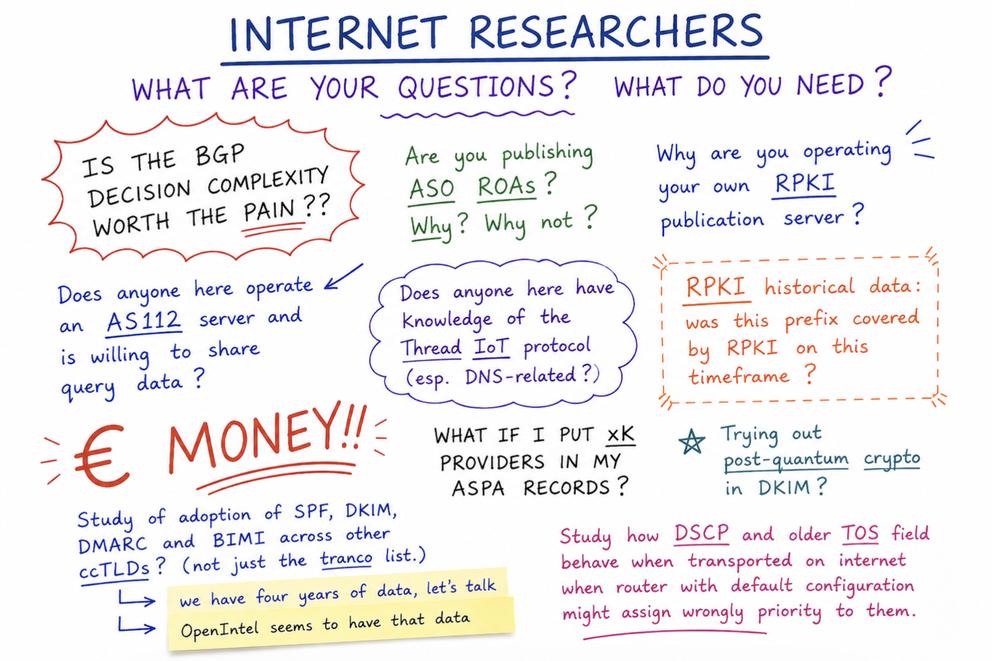
To explore whether we could make these connections easier, we ran a simple experiment at RIPE 92. A paper flip chart was placed in the meeting area for the week. Framing questions were primarily posed to researchers, inviting them to share open questions and requests for collaboration that could spark useful conversations.
The idea was intentionally lightweight. Rather than doing a formal matchmaking, the flip chart simply made potential collaboration opportunities visible to everyone attending the meeting. Attendees could browse the questions, add their own, and identify people with whom they wanted to start conversations. The results were encouraging: several researchers connected with operators who could help take their questions further.
The trial was intended as a first step rather than a finished solution. By keeping it simple, we wanted to learn two things: whether making collaboration opportunities visible would help researchers and operators find one another, and whether the community saw value in such a mechanism at all.

Ideas for encouraging collaboration
The flip chart experiment concluded with an open discussion during a dedicated side session on Thursday. While there was broad agreement that making connections easier is valuable, the discussion highlighted several different ways the community could lower the barriers to collaboration. These ranged from making data easier to access and share, to creating more opportunities for researchers and operators to meet.
Lowering the barriers to data sharing
One idea was to develop a reusable legal framework that organisations could adopt when sharing data for research purposes. Rather than each collaboration starting from scratch, a common template could define topics such as:
- What data is being shared
- How it has been anonymised or aggregated
- How the data may be used, stored, and published
- What are the responsibilities of both the data provider and the researcher
Some participants also noted that technical tooling to support this process, such as automating data extraction and anonymisation, could further reduce the effort required for operators to participate.
Building a shared repository
Participants also discussed the value of making anonymised operational datasets easier for researchers to discover and access.
Beyond the datasets themselves, the platform could capture important context, including:
- What was measured and why
- Who provided the data
- Who can answer questions about the dataset
- Any limitations or assumptions
- The conditions under which the data may be used
A framework like this could also help address questions of trust and access control, particularly where data is sensitive.
Creating regular opportunities for dialogue
Finally, participants observed that successful collaboration depends on more than data alone. Researchers and operators also need regular opportunities to discuss problems, exchange ideas, and identify questions worth investigating.
One suggestion was to establish recurring matchmaking sessions focused specifically on research collaboration. Rather than presenting completed research, these discussions could focus on open questions, operational challenges, available datasets, and opportunities to form collaborations from the outset. Such a forum could complement the existing meeting structure by helping researchers and operators connect earlier and build relationships around questions of mutual interest.
Continuing the conversation
The discussions at RIPE 92 suggested that there is interest in making it easier for researchers and operators to find each other and collaborate. The flip chart experiment and the follow-up discussion also highlighted that there is no single solution: stronger collaboration may require a combination of practical tools, clearer processes, and more opportunities for dialogue.
To continue this conversation, we are organising a Birds of a Feather (BoF) session at the RIPE 93 Meeting in Sofia (26-30 October, 2026) focused on collaboration between researchers and network operators.
The goal is to provide a space for the community to discuss what kinds of support mechanisms would be most useful, what barriers need further attention, and what role the RIPE community could play in supporting these efforts.
The discussion is open to anyone interested in bringing researchers and network operators closer together. Hope to see you there!
Comments 0