

IPv6-Only vs IPv6-Mostly: Appropriate Use Cases

• 9 min read
Not all IPv6 deployment models belong in the same flock. IPv6-Only and IPv6-Mostly are often discussed as if they were interchangeable, but each was designed for different environments. This article explores why matching the right approach to the right use case matters.







“The idea to carve out a block and let the RIR's handle it is already making an assumption. Who says that there are only 5? Why wouldn't the moon or Mars have their own registries when they get colonized? One of the reasons i was so annoyed at ARIN handing out a /16 is because that way we WILL run out. Assume we figure out FTL and colonize a thousand planets, each having their own Planetary Internet Registry. If you hand out 64 /16's each on a thousand planets, congratulations, you've just exhausted the inexhaustible IPv6! Routing is a not-trivial issue, but filtering is one as well. When your spacecraft has limited bandwidth, do you allow the entire internet to ping/poke it? Looking forward to the interesting things that this problem will bring forth...”
That's why I was indicating "objects/missions" and restricting the usage, so not for planets. I think they are a very different scope. In any case, if a planet is colonized, considering the cost of communications with earth, probably it makes sense to have just a few "space providers" for that planet. They will be like our current LIRs and they can assign /48s from their /32 or whatever bigger block they got. It is clear than in hundreds of years (I don't expect this happening just in 50-100 years) we may colonize not one but several planets. However in that time frame, probably we had another IP version, not just because we exhausted the addresses, but because we have many other technical requirements that we couldn't fulfill with IPv6.
I would not start form /64 neither /3. I think every "space object/mission" (to use somename) should have its own /48, as we aren't talking about planets, right? I don't know if they expect that several space objects, for example in the moon, from the same "provider" will aggregate multiple /48s, in something shorter and how they manage, but this is another discussion. I think the real problem is to do an approximation of how many /48s will be needed in "n" years. They could be aggregated in "n" /32 (we are used to that number, so for this example considering this one as well). And then how many "providers" are expected in total for those "n" years. 100 or 1.000 ? Which that we get something like /16 (just an example). The IETF defines a single /16 reservation for TIPTOP, but in a different /3. Only if 80% is already allocated then can be extended to a /15, and so on. This way we don't have the risk to waste a complete /3 in a single shot. And we have been there. It is a mix of IETF standards to define how IANA manage that, and a global policy that needs to be agreed among all the RIRs for the "space providers". Of course, there are a lot of additional technical difficulties as you mention in your draft (and article), but I don't think the IETF+global policy part is so different than what we have already done before. The point here is to consider a new type of "provider" the "space providers" in a common way among all the RIRs.
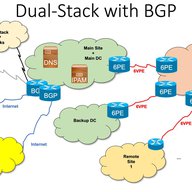
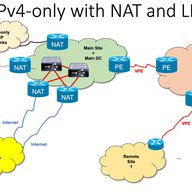
“In the diagram, why are the IPv6-related options rendered in orange, suggesting danger, while the IPv4-related options are all rendered in green, despite their generally higher cost and/or longer lead times?”
Very good points ... I guess was not on purpose, but worth considering replacing the colors and making sure it doesn't happen again.
“Jordi, you bring up good points about 464XLAT and CGN challenges. But why label Jolita’s comment as spam? IPXO is the only platform fully compliant with all RIR policies, supporting thousands of businesses globally in accessing IPv4 addresses. Isn’t that a valuable solution for those still navigating the IPv6 transition?”
Because articles aren't to promote specific companies? I don't think, in general, any company should be allowed to be self-promoted by "opinions" in an article. Not going to respond if IPXO or other brokers are or not fully compliant with all RIR policies ... Not planing to loop around this thread, so not responding again to this kind of questions.
“IPv4 leasing would be a fantastic addition to the list, since it's a quick, flexible way to get IPs without the long-term commitment. IPXO makes it easy and affordable to lease and manage them. Worth considering!”
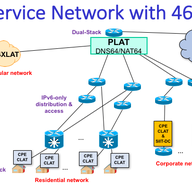
The previous message clearly is a marketing spam and I don't think should be authorized, specially considering that the report already mention leasing (renting). Instead, I think the report is missing the use of 464XLAT (IPv6-only as a Service), as a cheaper way to avoid CGN. Also the report doesn't mention the danger of CGN, with services such as Sony PSN that block for ever the IPv4 ranges used in CGN, so the cost of the CGN and every 6-8 months of IPv4 address space, exceeds the cost of an actual IPv6-only with IPv4aaS deployment.
I feel that the main problem in this region is that we allow a "wild west" by not requiring justification of the need in transfers and we should resolve that. Same with the lack of policy regarding leasing. All this clearly goes against the community and the membership. To make it worst, address-policy WG chairs ignore proposals from community members which will facilitate the allocation of IPv6 (avoiding the need for at least some of those transfers), against the PDP, and discriminate those members by "selecting" by themselves that a later submitted policy proposal is accepted or presented in the WG instead of the 1st one already submitted much ahead, disallowing the normal community defined process, presumably even against the code of conduct. No wonder that the community just don't care and avoids investing time in discussing topics that the staff warned about and some participants submitted proposals that have been ignored, for example for the ASs. Going back to the specific topic in this posting, it will be interesting to know if the NCC is getting escalated abuse reports coming from those IPv6 blocks or any other information that can tell us how much of that space is being used for good and bad.
A clear change should be the title of the ICP-2, something like "ICP-2 - Criteria for the establishment Regional Internet Registries and obligations for their continued recognition"
“Hi, Jordi: 0) There is still time. 1) Please have a look at the following discussion thread on the "state of IPv6", http://www.circleid.com/posts/20190529_digging_into_ipv6_traffic_to_google_is_28_percent_deployment_limit/ 2) Then, you may like to have a look at the feasibility demonstration report below about our proposal for expanding IPv4 address pool, etc.: https://www.avinta.com/phoenix-1/home/RegionalAreaNetworkArchitecture.pdf These should provide some material for furthering the dialog. Abe (2020-08-29 22:31 EDT)”
The Ericsson publicacion has a lot of wrong misconceptions as starting point and consequently, anything that starts from there, is broken. When and if IETF approves the use of 240/4, and all the vendors start having firmware updated to users to support it, then we can talk about this. Meanwhile, the only solution *BEING* deployed, is IPv6.
Very informative. Thanks a lot! I love the "legacy IPv4" bit :--)
Hi Axel, I can't let you go without saying this: Yes please, join the mailing list. Now that you will be non-staff (I always said that staff is also community and should be able to speak openly from a personal perspective + additional knowledge), you can contribute a lot with your "internal" knowledge of so many aspects that aren't easy to see from the community side. Thanks!
Showing 28 comment(s)